
Travel is a perfect opportunity to disconnect. You’ll probably find yourself in a new and exotic location with plenty of things to see and do. But in the real world, most of us are completely reliant on our smartphones while travelling for everything from navigation to translation and, of course, sharing stuff on social media. That’s why finding a good travel SIM for your trip is essential.
Doing some research before you leave is a great first step, so if you’re reading this, well done! You basically have three main options when it comes to finding the right overseas SIM option: you can use a SIM from your country, order an eSIM online, or buy a SIM once you reach your destination.
I have experience with all three options. I’ve used dozens of different travel SIM cards and eSIMs across more than 40 countries and have learnt quite a few things along the way.
Unfortunately, there’s no single ‘best travel SIM’ out there. It completely depends on where you’re coming from, where you’re going to and what your needs are. However, I’m here to help you figure out what options are available and to narrow them down to find your best travel SIM.
Roaming from home
Let’s begin with the SIM card a(or eSIM) in your phone right now. Most companies now offer international roaming add-ons for your plan or pre-paid service. These are certainly better than the old days of accidentally being charged thousands of dollars for just glancing at your phone overseas.
In Australia, the largest mobile network operator, Telstra, has an International Roaming Day Pass for customers on a plan. This includes 2GB plus unlimited calls and texts in 80+ countries for $10 per day. The price lowers to $5 a day if you’re heading to New Zealand or six other Oceania countries.
Meanwhile, International Roaming Packs are available on Telstra pre-paid across 38 destinations, including the $25 14 Day Travel Pack with 4GB of data, 50 SMS/MMS and 50 minutes of calls.
Telstra may be appealing in certain circumstances. For example, they seem particularly suited to business travellers on short overseas trips who need to stay connected with their existing number. Hopefully their workplace foots the bill, because $10 a day adds up quickly!
Other major operators
Optus is generally more competitive than Telstra when it comes to international roaming prices, data inclusions and global coverage. For $5 per day, Optus Daily Roaming provides 5GB of data and unlimited calls and texts in 150+ destinations to those on the company’s Choice Plus plans.
The roaming options on Optus pre-paid are also pretty interesting. They include a $75 International Roaming add-on with 15GB, 100 SMS and up to 100 minutes of calls on a 186-day expiry.
Like Telstra, Optus may be attractive depending on your situation. They are more affordable and more generous with their data inclusions than Telstra, however $5 per day still isn’t that cheap.
Vodafone, which pioneered $5 roaming in Australia, works slightly differently than the other two big operators. Rather than selling add-ons with different inclusions, Vodafone $5 Roaming lets you use your existing plan’s data, calls and texts in over 100 destinations for $5 a day.
For those not on a plan, there are also three Vodafone Prepaid Roaming Add-ons, the most generous of which provides 7GB of data, 250 texts and 350 minutes of calls for $35 with a 7-day expiry.
There is something to be said for the simplicity of roaming add-ons from Telstra, Optus and Vodafone if you’re already a customer. Otherwise, I don’t think they’re appealing enough to change providers and also, in most cases, there are more affordable options out there with more data.

Beyond the big players
Speaking of more affordable, there is another Australian operator that I want to highlight before moving on to dedicated travel SIM cards and eSIMs.
Felix Mobile is owned by TPG Telecom and operates on the Vodafone network in Australia. They sell SIM-only plans with a fairly unique feature: pausing your plan for up to 119 days. That might not seem very relevant, but Felix lets you continue using international roaming packs while paused.
This means you can sign up to a Felix plan (with your current number or a new one) before heading overseas, buy their $20 roaming pack and then pause the plan. You’d then have almost four months to use the pack’s 4GB of data, 100 minutes of calls and 100 SMS in 40+ destinations.
Plans with Felix start at $25 per month but they often have sign-up discounts that are even cheaper. There is also a referral system so you can give a friend a discount while getting yourself some credit.
A $25 plan + $20 roaming pack with 4GB may not seem like amazing value. But if you transfer your existing number, you won’t be paying for a plan in Australia that you’re not using. You have the option of purchasing multiple roaming packs (so long as you do it while unpaused). You can also unpause your plan if you’re close to hitting the 119-day threshold and pause again later.
I’ve used Felix in combination with data SIMs that I’ve picked up at my destinations and it has been great. Felix’s 4GB of data isn’t a lot, but it let me connect as soon as I landed in each destination and kept me online between different countries.
Local travel SIM sellers
Looking beyond the major operators in Australia, there are plenty of other companies that can help you stay online during your travels. Australian travel SIM providers can deliver a SIM directly to you in a few days. Having a SIM before you leave is a great way to reduce any uncertainty.
There are too many providers to name them all here. However, I will single out one that I’ve had great experiences with: TravelKon. Their website is easy to navigate. Just type in your destination/s to see what’s available. There are SIMs for specific countries as well as regions and worldwide.
TravelKon clearly lays out how each travel SIM works and any limitations. Shipping is also free and they regularly run discounts which you can find in their newsletter or on OzBargain.
I have used the Europe & UK SIM Card 44 Countries | Orange which I think is a solid deal. Make sure you read all of the provided information in advance and don’t assume anything. Just as an example, a “Europe” travel SIM card won’t necessarily work in every European country.
One negative part about any physical SIM provider is the actual SIM card itself. I have plenty of first-hand experience trying to swap SIMs in cramped airline seats. I have also accidentally dropped them. Thankfully, in recent years, another option has spiked in popularity: travel eSIMs.
All about travel eSIMs
Travel eSIMs offer all the features of travel SIM cards with none of the inconvenience. Rather than having to physically change SIMs, you can simply buy one online and load it onto your compatible device. You can even have multiple travel eSIMs loaded up ready to go.
This opens up your possibilities to an almost overwhelming degree. There are so many travel eSIM providers out there and new companies are entering the space all the time.
To cut through the noise, I highly recommend eSIMDB. They have a catalogue of 200,000 data plans from more than 120 brands. Enter a country or region and you’ll be met with a long list of options. You can then apply filters to find the right travel eSIM for you.
After I’ve put in my destination, I start by filtering by the length of my trip. At first, I don’t touch the data and price filters unless I specifically know the amount of data I will need and/or the maximum amount of money I want to spend. Then I’ll apply four more filters:
- Hide plans with possible throttling – So-called “unlimited” plans often still have limits
- Hide plans with maximum speed limits – Data speeds can be important while travelling
- Hide plans with daily data caps – A larger pool of data is more flexible than a daily cap
- Hide subscription-based plans – Having to cancel a subscription is an unnecessary hassle
Finally, I sort all of the results by ‘Best price/GB’.
Understanding eSIMDB
Let’s look at the results for a sample three-week trip to New Zealand:
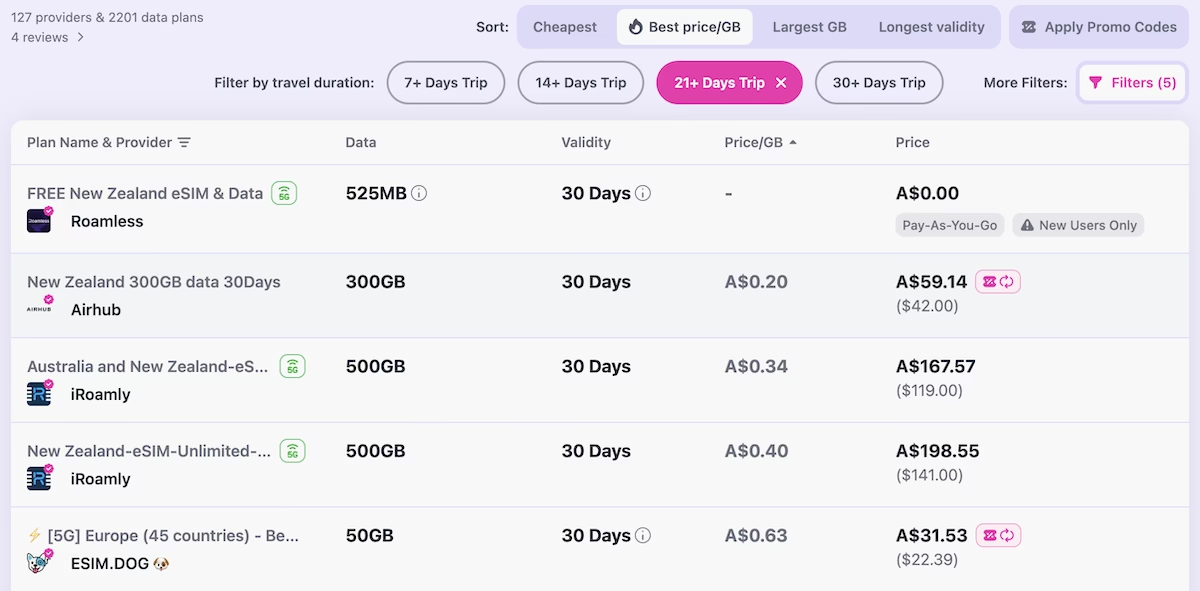
This is a perfect example of the kind of results you can expect. The first option from Roamless is essentially a free trial eSIM. This is great for testing, but we’re looking for something we can actually use so let’s ignore it. The next few options all include lots of data for quite a lot of money. Finally, the ESIM.DOG option is interesting… except New Zealand isn’t in Europe as far as I know.
eSIMDB is solid but not perfect, so keep an eye out for mistakes like this as well as pricing errors.
After looking over the results, let’s use the data and price filters to narrow things down more. I recommended against doing this earlier because you can accidentally filter out good options.
As a hypothetical, Company X has a 100GB eSIM for the grand sum of $1. You’d miss this if you set the filter to 5-10GB of data. Similarly, maybe Company A is selling a 10GB eSIM for $21 while Company B has 1GB for $20. If you set $20 as your max price, only the latter option would show.
For our New Zealand example, we don’t see any standout situations like this, so let’s filter. We want 10-20GB over 21 days (averaging ~0.5-1GB per day) for under $30:
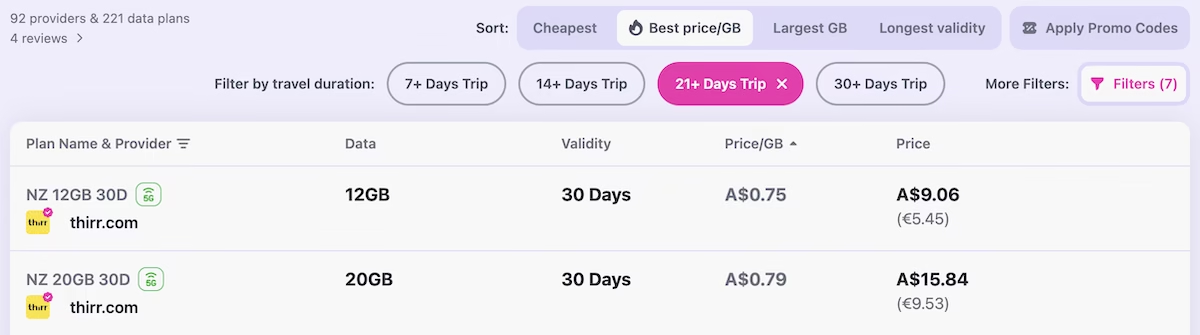
These two results seem to fit the bill. They’re 75-79 cents per GB, cheaper than the next best options by almost 25%. They’re also 5G, as can be seen by the green icon next to each plan name.
Before making a decision about what to buy, ensure that the provider is reliable with good customer service. Look for reviews directly on eSIMDB and do a quick Google search as well.
Pick up a travel SIM on arrival
Now we’ve gone over two options that involve a bit of prep work prior to your trip. So what happens if you just rock up and get a SIM at your destination? This can have both pros and cons.
You might find something that’s cheaper or better than anything available online. If this is your strategy, go with a company that locals recommend. If they’re a major brand, you may be able to get advice and assistance from someone at a store. You’ll also be connected directly to a network rather than being routed through a third party. Just try to avoid SIM cards aimed at tourists. These are generally overpriced, but there can sometimes be exceptions.
On the other hand, waiting until you land means that you’ll be without data until you get a SIM. You’ll have to find a store that sells SIMs, which can be surprisingly tricky in some countries. You may be required to visit a company’s store during business hours, deal with long lines, fill in paperwork, provide personal identification and cope with language barriers.
Buying an eSIM online from a company based at your destination is one way to receive all the benefits of a local SIM with none of the downsides of physically getting a SIM. These aren’t available in that many places though and you might only be able to get those expensive tourist SIMs.
I almost always have a travel SIM organised in advance unless my Googling shows that there’s a significantly better local option. If you’re like me and prefer to have things planned out, just having your data sorted before departure can be worth a few extra bucks.
Travel SIM note: know your networks
One final detail, which is relevant regardless of what type of SIM you use, is about phone networks. Most people know which companies have the best coverage in their own country. This is also important information to know for any destinations you’re visiting.
You don’t want to be stuck on the worst network in the country, especially if you’re planning to visit areas outside major population centres. Mobile network operators, travel SIM providers and eSIM companies usually publish online which network/s they are partnered with in which countries.
A quick search will generally tell you whether people think a particular network is good or bad. You can even drill down into network maps to see whether you’ll have coverage in areas you’re going to.
Poor network coverage could leave you stranded in the middle of nowhere with no access to a map app. Network congestion might make it difficult to contact family or friends, even in a big city.
Always prepare for the unexpected. Download offline maps and, wherever possible, have a backup SIM or eSIM (ideally on a different network) to stay connected, especially if you’re travelling alone.
I keep a global eSIM with a small amount of data to fall back on if my primary data SIM fails. I personally use Eskimo, which sells a global eSIM with 1GB of data and a two-year expiry, but you can explore other global eSIMs on eSIMDB here.
Hopefully this article has helped you find a travel SIM that works for you!
Leave a Reply